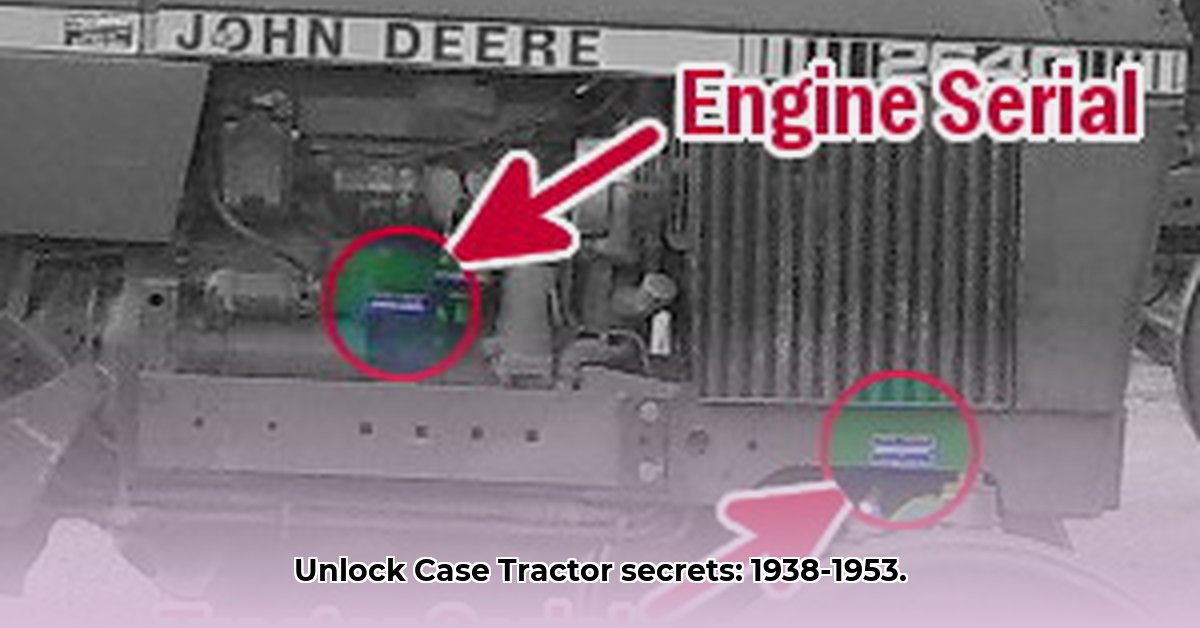
Dating a vintage Case tractor built between 1938 and 1953 can be challenging. Case's serial number system during this period lacked consistency, making precise year identification difficult even for experts. This guide provides a step-by-step approach to help you determine your tractor's approximate manufacturing year, acknowledging the inherent limitations of the available data. For additional resources, check out this tractor serial number lookup.
Identifying Your Case Tractor Model
Before decoding the serial number, you must identify your tractor's model. The serial number location varies significantly depending on the model. A precise model identification is crucial for success.
1. Visual Inspection: Begin by carefully examining your tractor. Look for model designation plates, often located on the instrument panel, under the seat, or near the engine. Take detailed photos of any identifying markings. Online image searches can help confirm your model.
2. Owner's Manual (if available): Your owner's manual will show you the exact location of the serial number for your specific model.
3. Case Tractor Serial Number Locations (Partial List): The table below provides likely locations for some common models. This is not exhaustive.
| Case Tractor Model (Examples) | Likely Serial Number Locations |
|---|---|
| Model "C" | Engine block, near the starter motor |
| Model "LA" | Rear of the transmission housing, often cast into the metal |
| Model "SC" | Engine block, near starter motor, or transmission housing |
| Model "DC" | Engine block, often near the oil pan |
| Model "40" | Engine block or transmission case |
Locating the Serial Number
Once the model is identified, the next step is to locate the serial number. Remember that wear, corrosion, or previous repairs might obscure the numbers.
1. Thorough Cleaning: Carefully clean the suspected area(s) with a wire brush, degreaser, and a suitable cleaning agent. This process will reveal partially hidden markings. Protect your tractor's paint with masking tape if needed.
2. Image Enhancement: After cleaning, take clear, well-lit photos, then use image-enhancement software to increase the contrast and sharpen the image of the serial number.
3. Consult Experts: If you are still unable to locate the serial number, seek assistance from local Case tractor enthusiasts or online forums.
Decoding Partial Information: The "Minus 4" Method (Use with Caution)
A common, yet unreliable, method suggests subtracting 4 from the first two digits of the serial number to estimate the year of manufacture. This works sometimes, but only for certain models, and is not guaranteed to give a correct answer. For example, if the first two digits are 46, the estimated year would be 1942 (46 - 4 = 42). However, this is often incorrect and should not be your primary method.
Advanced Techniques & Resources
Given the limitations of serial numbers alone, a multi-faceted approach is necessary.
Component Analysis: Examine the tractor's components for clues. Engine models, features like the type of carburetor or fuel pump, and the design of certain parts can indicate a particular manufacturing period. Researching Case tractor model timelines and variations provides vital context.
Parts Catalogs: Original Case parts catalogs are invaluable but challenging to obtain. Online resources may contain incomplete or inaccurate information. Libraries and agricultural history societies might have printed catalogs that will be more helpful.
Community Engagement: Connect with Case tractor enthusiasts online (on forums and social media groups) and offline (at local clubs or shows). They are an invaluable resource—their collective knowledge and experience can significantly aid identification.
Contacting Case IH: As a last resort, you could attempt to contact Case IH directly. However, locating the appropriate department and receiving a definitive answer might be challenging due to the age of the tractors.
Building a Collective Database
A crowdsourced database improves dating accuracy over time. Readers can contribute their findings (serial number, model, confirmed/estimated year) to a central repository. This approach protects individual privacy while significantly advancing our collective knowledge. Consider contributing your findings to forums or dedicated online repositories once you've completed your identification process. Protecting your personal information is of utmost importance to us.
Conclusion
Dating Case tractors from 1938-1953 presents considerable challenges due to inconsistent serial number systems. This guide provides actionable steps to determine the approximate year of manufacture, however, we strongly encourage the use of multiple methods and community engagement. Your participation in building a collective database is crucial for increasing the accuracy of future identifications. Let’s work together to unlock the history of these magnificent machines!